
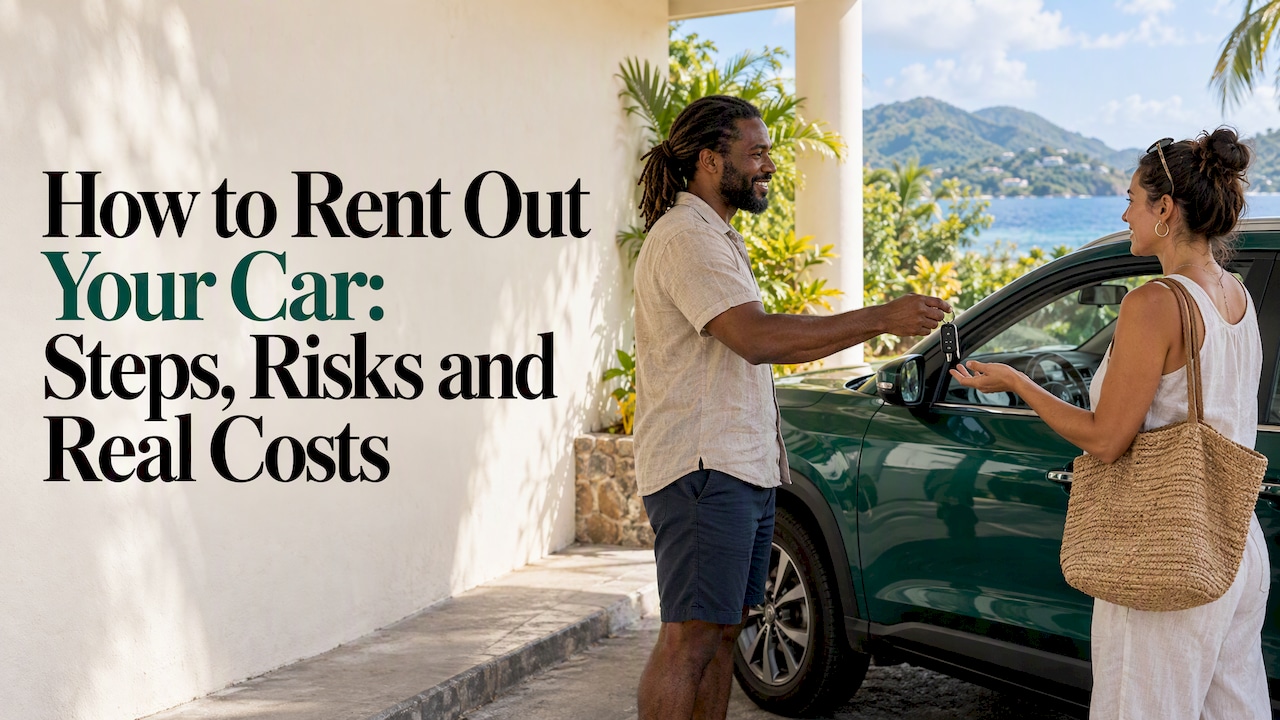
You can rent out your car by listing it on a peer-to-peer rental marketplace, describing it, uploading photos, setting your availability and price, and then approving or declining requests from renters. The hard part is not the listing. It is settling insurance, financing, taxes and wear before the first guest picks up the keys. This guide walks through each step in order, with the risks stated plainly, so you can decide whether renting out your car is worth it for you.
TL;DR
- Renting out your car means registering it on a peer-to-peer platform, confirming it is eligible, and accepting or denying booking requests.
- Your personal auto policy may not cover shared use, and platform insurance may apply only during active trips, so check both before you list.
- If the car is leased or financed, read your contract first: the lender may prohibit renting it out.
- Rental income is generally taxable, and extra wear, maintenance and gas are real costs to budget for.
- If your car is in the Caribbean, Yamo lets you list it with host tools for availability, pricing and payments.
Table of Contents
- How renting out a car actually works
- Is renting out your car right for you?
- Before you list: financing, insurance and eligibility
- Know the risks before you hand over the keys
- Step by step: how to list your car
- Money: what you earn, what you owe
- Perspective: what we tell new hosts
- List your car with Yamo
- Common mistakes to avoid
- FAQ
- Sources
How renting out a car actually works
Peer-to-peer rental platforms let you rent your car by the hour or by the day to people who find it through the platform, as the Federal Trade Commission describes. You are not a rental company with a counter and a fleet. You are a private owner whose car is listed in a marketplace, and the marketplace handles discovery, messaging and payment.
The basic flow, per Progressive’s overview, is short: check that your car and insurance qualify, register with a service, then confirm or deny rental requests. After that you coordinate drop-off and return, inspect the car, and report any damage quickly.
That simplicity hides the part that matters. You remain the owner, which means you carry the risk that something goes wrong between the platform’s protection and your own policy. Everything below is about closing those gaps.

Is renting out your car right for you?
The appeal is obvious: a car that sits in a driveway or airport lot all week can earn money. The honest version of the math has two sides. On one side is potential passive income. On the other, Capital One’s guidance tells owners to weigh extra maintenance and gas costs, insurance needs and the risk of repairs.
Renting out a car also speeds up wear and tear. Capital One notes that brake pads and tires need replacing more often, so owners should budget for that from day one.
Renting out your car tends to work best when:
- You own the car outright, or your lender allows shared use.
- The car is idle for long stretches, such as when you travel or work from home.
- You are comfortable with strangers driving something you depend on, or you own a second vehicle that is not essential.
- You can respond to booking requests quickly and inspect the car at each return.
It tends to work badly when the car is your only transportation, when your insurance is unclear, or when you are hoping for income with no effort.
Before you list: financing, insurance and eligibility
Check your loan or lease
If you lease or finance your vehicle, read the contract. Capital One warns that the lender or leasing company may prohibit renting the car to others. Call them and ask in writing. Finding out after a claim is the expensive way to learn.
Check eligibility
Every platform sets its own rules. Progressive lists the kinds of requirements to expect: personal auto insurance, age and mileage limits, a clean title and a vehicle value below the service’s cap. Read the current host requirements on the platform’s own page rather than relying on a third-party summary, because limits change and vary by state, country and vehicle.
Check your insurance
This is the step people skip. Three facts are worth knowing:
- Platform coverage may cover only active trips. The FTC warns that you could be responsible for damage or theft between bookings. Ask exactly what you are responsible for if something goes wrong.
- Your personal policy may exclude shared use. The Maryland Insurance Administration advises checking your personal auto policy because some policies may exclude peer-to-peer car sharing. Wolters Kluwer’s 2024 guidance adds that many personal policies do not cover liability from peer-to-peer sharing, some states let insurers exclude it, and extra platform or commercial coverage may be needed. Talk to your insurance agent before you list, and keep their answer in writing.
- State law differs. Maryland requires the owner, the driver, the car-sharing program, or a combination of them to maintain insurance covering the shared driver’s use, with limits at least equal to the state minimums, according to the Maryland Insurance Administration. Florida’s Statute 627.7483 requires a program to ensure specified liability, personal injury protection and uninsured motorist coverage during each sharing period, while allowing exclusions in an owner’s personal policy. These are two state examples, not a nationwide rule, so look up your own state’s insurance department.
If your car is on a Caribbean island, see how protection is set up on our insurance page before you decide.
Know the risks before you hand over the keys
The FTC is direct about this: listing a car publicly carries risks, including vehicle damage, theft and use by renters to commit crimes, all of which can be costly and slow to resolve.
Two practical points follow from that.
Your car’s general location is public. The FTC notes that the general location is visible to everyone, while people who book get more specific parking details. Do not list your home address as the pickup point if you can avoid it. A nearby lot, a hotel, or a meeting spot is safer.
Anti-theft gadgets help but are not foolproof. Key lockboxes, remote immobilization and app-based door locks can reduce risk, but the FTC says many need cell coverage to work. That matters on rural roads and on islands with patchy signal. Plan a backup for handing over keys.
Step by step: how to list your car
1. Pick the right type of platform
Your options generally fall into three groups: a large general peer-to-peer marketplace for everyday cars, a niche marketplace for RVs, motorcycles or classics, or private rentals arranged on your own. Private rentals give you full control and no platform commission, but you also carry all the screening, contracts, payment collection and insurance work yourself. For most owners, a marketplace is the safer starting point.
If your car sits in the Caribbean, or you own a vehicle there that you rent to visitors, a regional marketplace fits better than a general one. That is the gap Yamo is built for.
2. Register and describe the car
Per Progressive, you register through the service’s app or website, describe your car, upload photos, list its availability and opt in to the protection options. Be exact about trim, transmission, seats, fuel type and features. Renters book on details.
3. Prepare the car and take photos
Before listing, take photos or video of the car and set your parameters, such as rental length, mileage limits and smoking rules, as Capital One suggests. Those photos double as your evidence if you ever need to prove prior condition.
Use our vehicle rental host checklist to walk through readiness and safety: cleanliness, tires, lights, fluids, paperwork and what to leave in the glove box.
Photo basics that work on any platform:
- Shoot in daylight, in a clean, uncluttered spot.
- Show all four sides, the interior, the dashboard with the mileage, the trunk and any existing scratches.
- Keep your phone number, email and social handles out of descriptions and photos. Keep communication inside the platform.
4. Set a price you can defend
Look at what similar cars in your area charge, especially near airports and tourist spots. Then subtract your real costs: platform commission, cleaning, fuel you will not recover, tires and brakes, and the insurance deductible you may owe. A price that looks generous on day one can leave you flat once the first repair lands.
Start competitive to collect a few good reviews, then adjust as demand shows itself. Seasonal demand matters too. In the Caribbean, winter and holiday weeks usually run busier than the rest of the year.
5. Set availability and rules
Block the dates you need the car. Set minimum and maximum trip lengths, mileage allowances, fuel and cleaning expectations, and who may drive. Clear rules written in the listing prevent most disputes.
6. Handle requests, pickup and return
You will get requests to confirm or deny, and you coordinate drop-off and return. When the car comes back, inspect it right away and report any new damage promptly so the claim is timely. Walk around it with the renter if you can, photograph the odometer and fuel level, and send those photos through the platform.
Money: what you earn, what you owe
Honest earnings depend on your car, your city, your season and how often it is booked, so be skeptical of any promise of a fixed monthly figure. Build your own estimate: expected booked days times your daily rate, minus commission, cleaning, fuel, maintenance and insurance costs.

Taxes are not optional. The IRS says sharing-economy activity is generally taxable, whether it is part-time or a sideline business. Keep records of every payout and every expense, and ask a tax professional how to report the income and which costs you can deduct. If your car is in the Caribbean, ask about local tax rules there as well.
Perspective: what we tell new hosts
We built Yamo as a peer-to-peer vehicle rental marketplace for the Caribbean, connecting local owners with travelers and business visitors. Talking with owners, we find the same worry underneath every question: will I stay in control?
Our answer is to put control in the owner’s hands. Hosts use a dashboard to list vehicles, manage availability on a calendar, set rental rules and pricing, and process payments. We earn a commission on each completed rental, and we make the commission structure transparent so you know what you keep before you list.
Our advice, in order of importance:
- Settle insurance and financing before anything else.
- Be strict about condition photos and handover checks.
- Price for your real costs, not for the biggest number.
- Treat every guest message as part of your listing’s reputation.
The islands reward owners who are reliable. A clean car that is ready on time earns repeat renters and strong reviews, and that matters more over a year than any single rate.
— the author
List your car with Yamo
If your vehicle is in the Caribbean, you can list it with us. Hosts get onboarding guidance, listing management tools, a calendar, rental rules and pricing controls, and payment processing, with a clear commission on completed rentals. Read how it works first, then become a host when you are ready.

Want to see the renter’s side first? Browse the cars guests see on Find a Rental, and read how we approach safety and trust and host verification.
Common mistakes to avoid
- Assuming your policy covers it. Ask your agent directly. Assume nothing.
- Ignoring the lease. A prohibited rental can create contract trouble with your lender.
- Listing with weak photos. Dark, cluttered or few photos lose bookings to cars that look cared for.
- Skipping inspections. If you do not document condition at pickup and return, a damage claim becomes your word against theirs.
- Forgetting downtime costs. Between trips, protection may not apply, so keep the car secured and know what you owe if something happens.
- Not tracking income. Track payouts and expenses from the first booking, not at tax time.
FAQ
Can I rent out my car if I still owe money on it?
Sometimes, but not always. The lender or leasing company may prohibit renting the car to others, so read your contract and ask them before you list. Get their answer in writing.
Will my personal car insurance cover rentals to other people?
Often not. Regulators such as the Maryland Insurance Administration warn that some personal policies exclude peer-to-peer use. Ask your agent, and check what the platform’s protection covers and when.
Do I have to pay taxes on rental income?
Generally yes. The IRS treats sharing-economy income as taxable, whether it is part-time or a sideline business. Keep records and ask a tax professional how to report it for your situation.
How do I keep my car safe when strangers drive it?
Vet your platform’s protection, document condition with photos at every handover, and keep your exact address private. Lockboxes and app-based locks can help, but many need cell coverage, so keep a backup plan for handing over the keys.
Can I rent out a car in the Caribbean through Yamo?
Yes, if the vehicle is in one of the Caribbean destinations we serve. Start with our host page and the host checklist to check that your car is ready.
Sources
- Peer-to-peer car sharing: A potentially risky side gig, Federal Trade Commission
- How to Rent Out Your Car, Progressive
- Things To Consider Before You Rent Your Car Out, Capital One
- Thinking of Renting Out Your Car to Make Cash? Capital One
- Insurance and Peer-to-Peer Car Sharing, Maryland Insurance Administration
- Florida Statutes section 627.7483 (2023)
- How to start a car sharing business, Wolters Kluwer
- Basic tax tips help you navigate the sharing economy, IRS
Leave a Reply